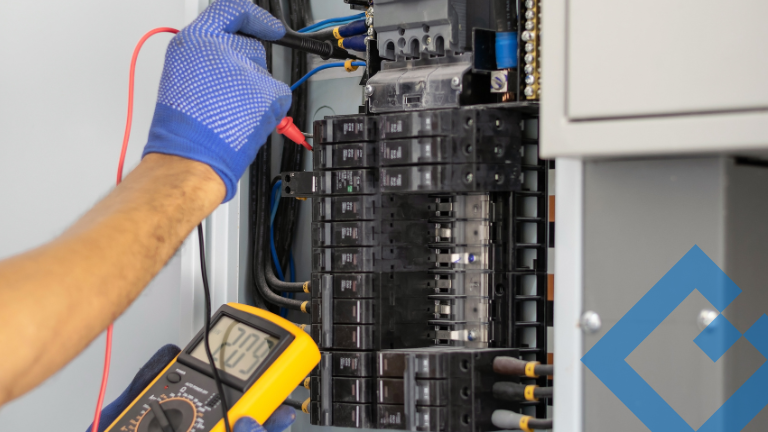
An EICR test (Electrical Installation Condition Report) is a formal inspection and testing process that assesses the condition of a property’s fixed electrical installation.
For electricians, it’s the job that proves you’re thorough, compliant, and professional, and it’s often the difference between being seen as “someone who can do electrics” versus a contractor clients trust with ongoing safety and maintenance.
EICRs matter because they’re tied to legal and contractual obligations. In England’s private rented sector, landlords must ensure electrical installations are inspected and tested at least every five years by a qualified person (and provide the report as required).
From a business point of view, EICRs are also one of the cleanest ways to build predictable work:
- They create repeat inspection cycles (and reminders you can systemise).
- They surface remedial work that’s easier to justify when it’s properly documented.
- They help you win or retain property maintenance contracts because compliance is non-negotiable.
This guide gives you a practical, on-site-friendly EICR test checklist, explains how to document results in a compliant form, and shows how electricians can run EICR work without drowning in admin using electrical field service software like BigChange.
What Tests Are Required for an EICR?
A compliant EICR combines a detailed visual inspection with a set of instrument tests recorded per circuit. The British benchmark standard that electricians are required to work to is BS 7671 (18th Edition), including Amendment 2 (2022). Inspection and testing practices are commonly guided by IET’s Guidance Note 3: Inspection & Testing.
For reference, here is an EICR form example in BigChange so you can see how it is typically structured in practice and reference as a template.
Below are the core requirements electricians should check and record.
Visual Inspection
The visual is where good electricians separate themselves from box-tickers. It’s not just “a quick look around”, it’s the stage where you find the issues that explain later test results.
Key checks to record:
- Damage to accessories (cracked faceplates, loose fittings, scorch marks)
- Signs of overheating, arcing, or water ingress
- Poor workmanship or DIY alterations (incorrect cable types, exposed conductors, taped joints)
- Consumer unit condition (covers, blanks, labelling, secure fixings)
- Presence of required protection (for example, RCD protection where needed)
If you can attach photos and observations to the exact circuit or location, you’ll spend less time defending your report to landlords, agents, or facilities managers later.
Continuity Tests
A continuity test confirms that protective conductors form a complete, unbroken path. Using a low-resistance tester, the electrician checks that fault current can flow safely to earth. If the path is broken, protective devices may not operate correctly, increasing shock risk. Checks include:
- Main earthing conductor continuity
- Main protective bonding continuity (gas, water, structural steel, where applicable)
- Ring final circuit end-to-end tests (r1, rn, r2), plus cross-connect checks as required
Continuity failures are often straightforward remedials (bonding upgrades, ring repairs, re-terminations). Documenting values clearly means you can quote remedials with confidence and avoid “it was fine before you touched it” conversations.
Insulation Resistance Testing
Insulation resistance testing helps you identify degradation between conductors and earth. A typical approach includes:
- 500V DC testing for most circuits (with sensible adjustments where equipment is sensitive)
- Ensuring sensitive equipment is disconnected where required
- Recording results clearly in MΩ on the test schedule
IR results are one of the biggest sources of “grey area” unless they’re captured properly. A clean digital schedule with notes (what was disconnected, what was isolated, where readings were taken) makes your report far more defensible.
Earth Loop Impedance Test
Earth loop impedance testing checks whether fault current will operate protective devices within the required disconnection times. Typically:
- Test at the extremity of each circuit
- Compare measured values against the relevant limits
- Use the correct method on RCD-protected circuits to avoid nuisance tripping
Recording extremity locations and results accurately reduces repeat diagnostics later.
Polarity Checks
Polarity checks verify correct connections and that protective devices operate on the live conductor. Common defects include:
- Reversed polarity at sockets
- Switched neutrals on the lighting
- Borrowed neutrals between circuits
Polarity faults are safety-critical, and clients rarely understand them. Your job is to explain clearly what’s wrong, why it matters, and what you did to make it safe, and your paperwork needs to reflect that in plain English.
Functional Testing Of RCDS / RCBOs
RCDs and RCBOs must be tested to confirm correct operation and trip performance. Your form should capture:
- Device details (rating, type, location)
- Trip test results and times (where applicable)
- Notes if testing is restricted or not possible
Missing or non-functional RCD protection is one of the most common reasons landlords need urgent remedial work. If you can trigger remedial jobs straight from the EICR record, you protect revenue and reduce admin leakage.
Internal Inspection Of A Sample Of Accessories (Typically ~10%)
On larger jobs, it’s common to sample a proportion of sockets, switches, and luminaires to check wiring and terminals for quality and safety
You should:
- Isolate safely
- Remove plates
- Inspect terminations, CPC presence, conductor condition, and overheating signs
Sampling is where you protect yourself. If your sample reveals widespread issues, you can justify expanding the sample or flagging the need for further investigation.
Verification Of Earthing And Bonding
Earthing and bonding are often where older installations tend to fail, so to verify the installation is safely earthed and bonded as necessary, your EICR should confirm:
- Earthing arrangement and adequacy
- Bonding presence and continuity
- Correct conductor sizing and secure terminations
Bonding work is high-value, low-drama remedial work when you can evidence it properly. The clearer your “before” condition report and your test values, the quicker you’ll get approval to proceed.
What Do C1, C2 and C3 Mean in an EICR Report?
Classification codes decide the outcome of the entire EICR and what happens next for the client, the property, and your business.
Each observation recorded during an EICR must be assigned a code that reflects the level of risk it presents. These codes are what landlords, letting agents, facilities managers, insurers, and local authorities look at first when reviewing a report.
If you record any C1’s or C2’s, or unresolved FI’s, the report is automatically unsatisfactory.
C1 Danger Present
If a C1 is present, this means that there is an Immediate risk of injury. Some examples of C1 codes are:
- Exposed live parts
- Damaged accessories with accessible metalwork
- Missing covers exposing busbars
C1’s often mean you must make it safe there immediately, and then proceed. If your process includes photos, “made safe” notes, and signatures, you reduce liability risk and protect your reputation.
C2 Potentially Dangerous
This is not necessarily an immediate hazard, but likely to become dangerous under fault conditions. Some examples are:
- Missing RCD protection where required
- High Zs readings
- Inadequate bonding
Typically, C2’s are where remedial pipelines come from. The faster you turn a C2 list into a priced, scheduled remedial job, the more profitable EICRs become.
C3 Improvement Recommended
A C3 is not generally dangerous, but they are below the current best practices. Examples include:
- Labelling improvements
- Upgrades that improve safety resilience
- In many cases, SPDs may be logged as C3 depending on context
You should look at C3’s as your “planned work” opportunities. They’re how you move customers from reactive fixes to scheduled improvements.
What Would Fail an EICR?
An EICR is marked unsatisfactory if it records any C1 or C2 observations, or if further investigation (FI) is required and not completed. No matter how good the rest of the installation looks, a single serious defect fails the report.
In practice, most failures come from a familiar set of issues, particularly in older, heavily altered, or poorly maintained properties. Knowing these patterns helps electricians spot risks faster and justify remedial work with confidence.
Damaged or Exposed Live Wiring (C1)
Any situation where live parts are accessible to touch is an immediate failure.
Common examples include:
- Cracked socket
- Missing switch plates
- Uncovered consumer units exposing live components
These faults are typically found in high-traffic areas and are classed as C1. Where possible, the electrician is expected to make the installation safe before leaving the site, either by isolating the circuit or carrying out an immediate repair.
Improper Insulation or Conductors (C1)
Perished insulation, heat-damaged cables, or poorly protected joints present a serious fire and shock risk.
These defects often show up in older wiring systems or where previous alterations were carried out to a poor standard. Where insulation breakdown could expose live conductors, often leading to partial or full rewiring recommendations.
Non-Fire-Rated Downlights Covered by Insulation (C1)
Older recessed downlights that aren’t fire-rated and have been covered by loft insulation are a common EICR failure.
The combination of heat build-up and combustible materials creates a clear fire risk, particularly where fittings or lampholders show signs of overheating.
Unsupported or Unsafe Light Fittings (C2)
Light fittings that rely on flex alone for support, or are inadequately fixed to ceilings, are usually recorded as C2.
While not always an immediate shock risk, mechanical failure could expose live parts or cause injury, especially in properties with frequent DIY fixture changes.
Poor Cable Entries and Terminations (C2)
Poor workmanship behind accessories and in junction boxes is a frequent cause of EICR failures.
Examples include:
- Missing grommets.
- Excessive stripping.
- Exposed copper near accessible openings.
These conditions increase the likelihood of insulation damage or accidental contact.
Missing RCD Protection Where Required (C2)
In simple terms, an RCD monitors the flow of electricity in a circuit. If some of that current is “leaking” — for example, through a person touching a live part or through damaged insulation to earth — the RCD trips and cuts the power, typically within milliseconds.
Typical failures include:
- socket circuits likely to be used outdoors,
- bathroom circuits, or
- buried cables without RCD protection.
Ring Final Circuits Failing Continuity Tests (C2)
Continuity testing sometimes reveals that a ring final circuit is broken or incorrectly configured.
Broken rings, inconsistent r1/rn/r2 readings, or circuits operating as radials on unsuitable protection increase the risk of overheating.
Unidentified or Poorly Labelled Circuits (C2 or FI)
Inadequate circuit identification can prevent safe isolation and fault-finding.
Where circuits cannot be confidently traced or labelled, the issue may be recorded as C2 or FI. Until resolved, the EICR remains unsatisfactory.
Incorrect Equipment Installed in Bathrooms (C2)
Bathrooms are high-risk locations, and failures here are common in older refurbishments.
Non-IP-rated fittings in splash zones or incorrectly positioned accessories increase shock risk.
Missing Surge Protection Devices (Usually C3)
The absence of surge protection devices (SPDs) is often recorded as C3 in domestic properties.
On its own, this doesn’t usually fail an EICR. However, alongside C1 or C2 issues, it contributes to an overall picture of an installation that would benefit from upgrading.
How to Prepare for an EICR Test
A smooth EICR starts before the electrician arrives on site. Good preparation keeps the inspection efficient, reduces disruption for occupants, and helps ensure the results are accurate and defensible.
For electrical businesses, it also means fewer call-backs, cleaner documentation, and a much better experience for clients who just want clear answers and compliance ticked off.
Step 1: Confirm the Scope and Obligations
Before anyone starts testing, make sure the scope is clear. Confirm which boards, outbuildings, EV chargers, or landlord supplies are included, and check the required inspection interval. Getting this right upfront avoids delays, confusion, and awkward conversations later.
Step 2: Review Previous Electrical Records
An EICR doesn’t happen in isolation. Previous reports, certificates, and board schedules give useful context and help electricians focus on known problem areas instead of starting from scratch.
Step 3: Make Access Easy
Access issues slow everything down. Consumer units, meter cupboards, lofts, risers, and locked rooms should all be accessible on the day. If access isn’t sorted in advance, expect missed circuits or a return visit.
Step 4: Plan Power Shutdowns
Some power interruption is unavoidable. Agree when circuits can be isolated and flag any critical equipment early, especially on commercial sites where testing may need to be staged.
Step 5: Get the Paperwork Right
The inspection is only half the job. Poor documentation creates delays after the fact. A clear digital workflow helps capture results once, issue reports quickly, and move straight into remedial work without chasing notes or retyping forms.
With risk assessment software from BigChange, your technicians and engineers can manage the job at hand with the correct documents, giving you reassurance and control right across your operation.
How Much Should an EICR Cost?
Pricing varies by region, property age, number of circuits, and access. Most “typical range” figures you’ll see published for domestic EICRs land roughly in the £120–£300 bracket, depending on property size and complexity, with 3-bed homes often quoted around the £190–£230 range in some guides.
How Long Does an EICR Take?
As a general rule, an EICR should take:
- 1–2 bedroom flat: 1.5–2.5 hours
- Typical 3-bedroom house: 3–4 hours
- Large or complex domestic property: 4–6+ hours
These timings assume reasonable access, a single consumer unit, and no major investigation delays. To better manage your time on these jobs, you can take a look at these handy field service tips for electricians.
For commercial properties, EICRs are usually measured in half-day or full-day blocks, often with multiple engineers, staged shutdowns, or out-of-hours working.
Time on site is usually driven by:
- Circuit count and distribution board layout
- Quality of existing labelling and documentation
- Age/condition of the installation (more investigation time)
- Occupied vs vacant access constraints
You should track your actual time per property type and circuit count. EICRs can look profitable on paper, but leak margin through overruns and admin. If your workflow captures test results once, on-site, and generates the PDF automatically, you keep the profit in the job.
Perform Your EICR Tests with BigChange
For many electrical businesses, EICR work doesn’t break down on-site; it breaks down around the job. That was the challenge facing Future Group, a growing building services contractor delivering electrical compliance work alongside planned and reactive maintenance. As the business scaled, managing inspections became time-consuming and hard to control.
By moving to BigChange, Future Group brought EICRs and other compliance work into a single workflow. Engineers could complete inspections digitally on site, attach evidence directly to each job, and submit reports without returning to the office.
The result was faster report turnaround, fewer admin bottlenecks, and a smoother transition from inspection to remedial work, turning EICRs into a repeatable, well-controlled part of the business.
“Since implementing BigChange, paperwork has become a thing of the past and we are far more efficient seeing, on average across the divisions, an 80% improvement.” - Maddie Carr, Service Agreement Manager, Future Group
Doing regular EICRs and fed up with juggling spreadsheets, paper forms and scattered certificates?
See how BigChange lets you log inspections, generate documentation, track remedials and store certification in one simple workflow.