Creating an accurate electrical invoice is a routine part of every job, but many electricians still spend hours preparing invoices manually after leaving the site. Others rely on inconsistent formats or forget key details such as VAT information, labour breakdowns, or payment terms. These small issues can slow down payments, create confusion with customers, and add unnecessary admin later.
For electrical contracting businesses, invoicing is more than paperwork. It plays a key role in cash flow, professionalism, and tax compliance. A well-structured invoice clearly shows what work was completed, how the costs were calculated, and when payment is due, helping customers pay faster while keeping your records aligned with HMRC requirements.
In this guide, you’ll find a free electrical invoice template along with practical advice on how to structure your invoices properly. We’ll also explain how to reduce payment delays, ensure your documents include the right information, and maintain accurate financial records.
As your business grows, many contractors also choose to move away from manual invoicing altogether. Tools like BigChange’s job management software for electricians can help automate quoting, job tracking, and invoicing in one system, making it easier to stay organised while getting paid faster.
Invoice Template for Electricians
Creating invoices from scratch after every job wastes time and increases the risk of missing important details. A structured electrical invoice template helps ensure every invoice includes the right information, follows a consistent format, and meets HMRC requirements.
To make things easier, you can start with a ready-made electrician invoice template designed specifically for electrical contractors.
Download your free electrician invoice template:
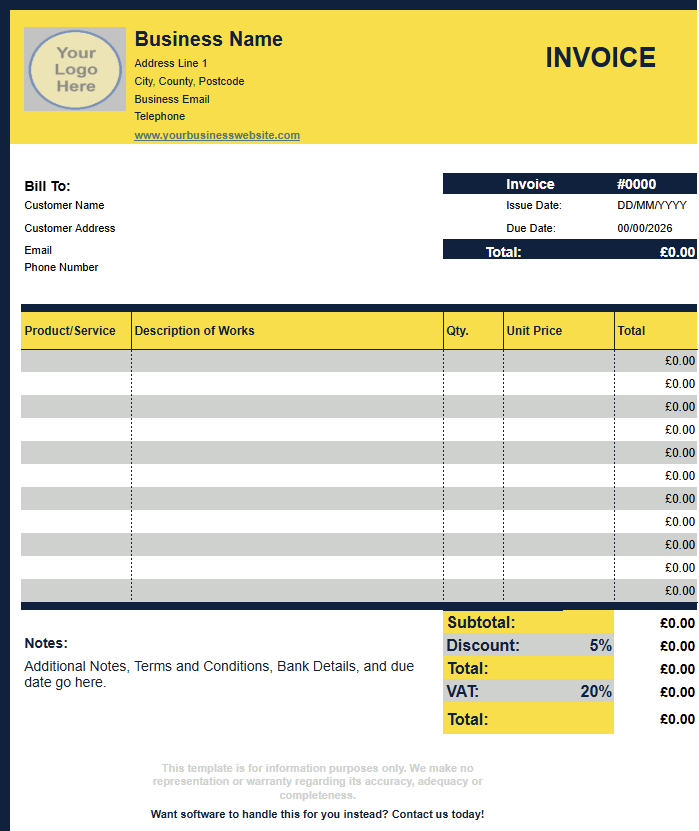
Using a template means you don’t need to rebuild invoices every time. Instead, you simply fill in the job details and send a clear, professional document to the client.
Items in a Typical Electrical Invoice and How to Write Yours
Once you have a template in place, the next step is ensuring each section of the invoice is completed correctly.
A well-written invoice reduces confusion and helps your business get paid faster.
Business and invoice details
Start by clearly identifying your business and the invoice itself. This ensures your documentation is professional and compliant with UK invoicing requirements.
Include:
- Business name and logo
- Registered business address
- Contact details (phone and email)
- Company registration number (if applicable)
- VAT registration number if you are VAT registered
- Unique invoice number
- Invoice issue date
- Payment due date
HMRC requires VAT-registered businesses to include their VAT number and clearly display the VAT amount charged on invoices. You can find official VAT invoicing requirements on the HMRC website.
Providing this information builds trust with clients and ensures your documentation meets UK tax rules.
Client Details
Your invoice must clearly identify the responsible party for payment.
Include:
- Client name or business name
- Billing address
- Job site address (if different)
- Contact information
This is particularly important when working with landlords, property managers, or commercial clients, where the billing contact may differ from the job location.
Work description and labour
Provide a clear explanation of the work carried out. Avoid vague descriptions such as “electrical work completed.” Instead, specify exactly what work was performed so the client understands the value of the service and how the costs were calculated.
For example:
Service: Replacement of faulty circuit breaker and safety testing of consumer unit
Labour: 4 hours @ £65 per hour
Labour total: £260
This breakdown helps the customer see:
- The specific task completed
- The time required to complete the work
- The hourly rate applied
If the job involves multiple tasks, you can list them separately. For example:
Electrical work carried out:
- Fault diagnosis and testing of circuit – 1 hour @ £65 = £65
- Replacement of circuit breaker – 2 hours @ £65 = £130
- System testing and certification – 1 hour @ £65 = £65
Total labour cost: £260
Providing this level of detail improves transparency and reduces the likelihood of disputes, particularly when working with landlords, property managers, or commercial clients who require detailed documentation for maintenance records.
Materials and additional charges
Any materials supplied during the job should be listed separately to ensure accurate cost recovery.
Examples include:
- Cable
- Switches or sockets
- Consumer units
- Circuit breakers
Electricians may also include additional fees, such as:
- Call-out charges
- Emergency repair rates
- Evening or weekend labour rates
- Travel costs
Emergency call-outs typically carry higher rates due to the urgency and disruption involved, so these fees should be clearly outlined on the invoice.
When it comes to call-out fees and guidance on similar charges, you can read more from the Joint Services Board to give you more insight.
VAT
If you are VAT registered, the VAT charged must be displayed clearly. Your invoice should show:
- Subtotal (before VAT)
- VAT amount
- Total amount due
Most electrical services in the UK are charged at the standard VAT rate of 20%, although certain energy-saving installations may qualify for reduced rates depending on current government policy.
Providing a clear VAT breakdown ensures your invoices remain compliant with HMRC rules and makes the final cost easy for customers to understand.
How to Manage Electrical Invoices to Get Paid Faster
Writing an invoice correctly is only part of the challenge. Managing invoices efficiently is what determines how quickly your business receives payment.
Late payments are a common problem across UK small businesses. Research from the Federation of Small Businesses shows that around 52 % of small firms experience late payments.
For electricians, that can mean waiting weeks or months for work that has already been completed.
The following practices can help reduce these delays.
Send Automated Reminders
Many late payments are simply caused by forgetfulness. A homeowner receives the invoice but becomes distracted. A commercial client may have an internal approval process that delays payment.
Without reminders, invoices can easily be pushed down the priority list. Automated reminders help keep payments moving.
For example, payment reminders can be scheduled:
- 3 days before the due date
- On the due date
- 7 days after the due date
Using systems like BigChange allows contractors to automate these notifications so customers receive reminders without manual follow-up.
This reduces the time your team spends chasing payments and helps maintain professional relationships with customers.
Digitise Invoices
Manual invoicing creates unnecessary risk to the business and can lead to human error, overcharging or undercharging, and is time-consuming.
Handwritten or spreadsheet-based invoices often lead to issues such as:
- Missing VAT information
- Incorrect totals
- Duplicate invoice numbers
- Lost records
Digital invoicing software solves these problems by automatically generating invoices from job records. Once a technician completes a job, the system can instantly convert the job details into an invoice including labour, materials and VAT calculations.
Future Group, a national property and facilities management company, faced challenges managing a growing number of field service jobs efficiently and struggled with manual paperwork for engineers.
By adopting BigChange, Future Group unified operations and improved communication. Engineers now capture job information digitally in real-time, which has improved data accuracy and allowed for faster, more accurate invoicing. This digital transformation has led to significant productivity gains and better control over their complex field service management needs.
“Since implementing BigChange, paperwork has become a thing of the past and we are far more efficient seeing, on average across the divisions, an 80% improvement, it was also fundamental to our winning the ARMA Partner of the Year Award.” Maddie Carr, Service Agreement Manager, Future Group.
For contractors, this kind of operational clarity reduces admin work and ensures invoices are issued quickly after jobs are completed.
Write Specific Payment Instructions
Unclear payment instructions often lead to unnecessary delays in payment. It is crucial to add the correct payment instructions to each invoice that you send out.
Customers may not know:
- How to pay
- Which reference to include
- When payment is expected
Clear instructions help avoid these issues. For example, your invoice might include:
- Payment is due within 14 days.
- Please reference the invoice number when making payment.
- Bank transfer details are listed below.
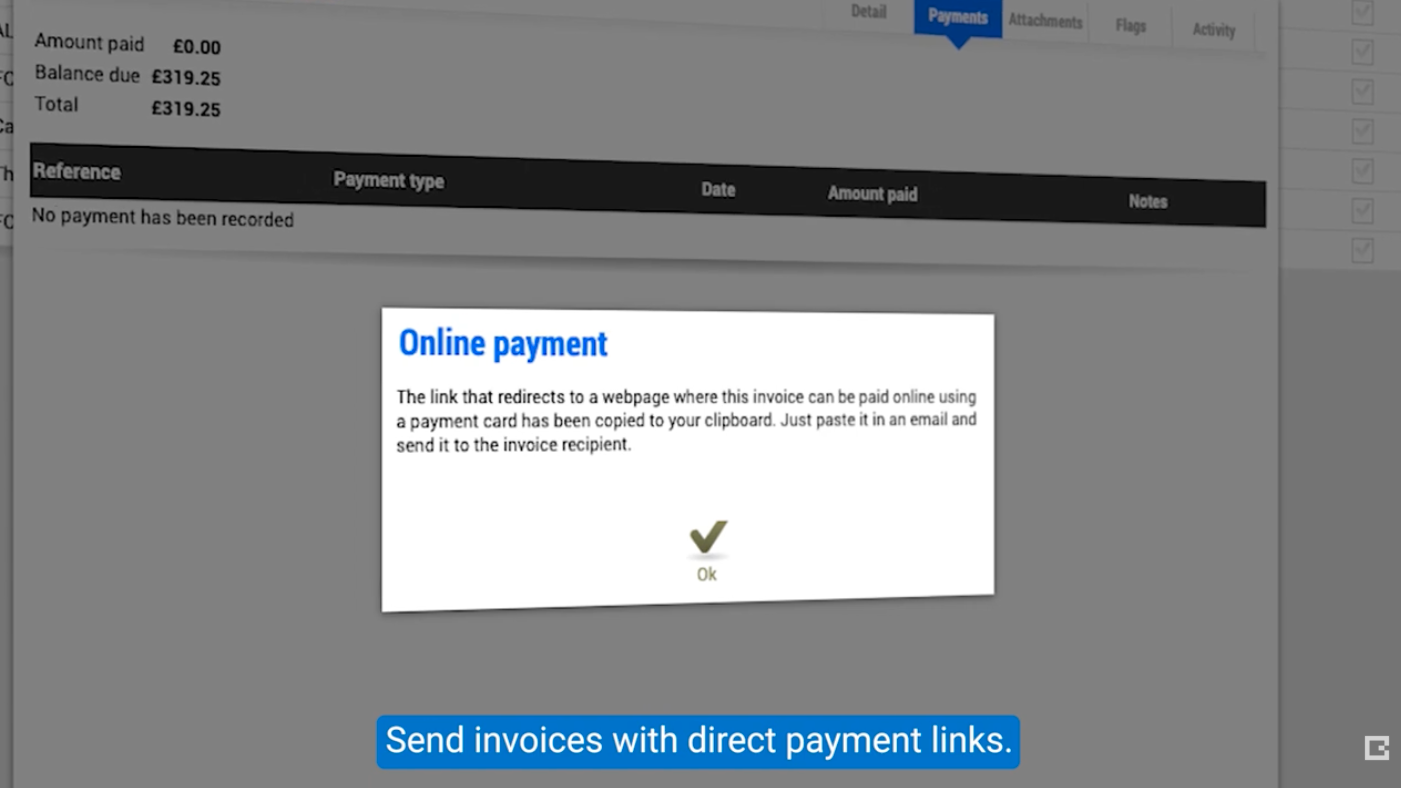
BigChange’s invoicing and payments feature can also embed secure payment links directly within the invoice, allowing customers to pay instantly using their preferred method. This removes friction from the payment process and eliminates the need for customers to manually transfer funds or request payment details.
Clear payment instructions and built-in payment options make it easier for customers to settle invoices quickly, helping electrical businesses reduce delays and improve cash flow.
To see how the platform works in practice, watch our BigChange payments and invoicing features video for a walkthrough of the tools available.
Streamline Electrical Invoices with BigChange
For growing electrical businesses, invoicing manually quickly becomes difficult to manage. Jobs increase. Engineers work across multiple sites. Materials and labour need accurate tracking. Without the right systems in place, invoicing becomes time-consuming and prone to errors.
BigChange helps electrical contractors manage the entire job lifecycle from scheduling to invoicing within a single platform.
With BigChange, electricians can:
- Generate invoices automatically from completed jobs
- Capture labour hours and materials from the field
- Apply VAT calculations automatically
- Send invoices directly to customers
- Track outstanding payments and reminders
Instead of spending hours on paperwork, your team can focus on delivering high-quality electrical work while the system manages the financial administration.
If you want to improve the way your business manages jobs, invoicing and payments, explore how BigChange supports electrical contractors.
Book a demo today and see how BigChange can help you manage electrical jobs, create accurate invoices and keep payments moving.