
Your electrical contractor profit margin is the share of each pound of VAT-exclusive revenue you keep after paying for the work and running the business. For a broad UK benchmark, Office of National Statistics figures in December 2019 showed an average profit margin of 9.3% for private non-financial businesses and 14.9% for service firms, as the Start Up Loans guide to profit margins reports. These are broad UK averages from December 2019, not figures for electrical contractors.
This guide shows how to work out your own gross and net margin, which UK costs sit between the two, and where margin leaks between a priced quote and a paid invoice. It is written for owners and managers of UK electrical contracting businesses.
What is a good electrical contractor profit margin in the UK?
A good electrical contractor profit margin is one that covers every overhead and still leaves profit to reinvest. There are no fixed rules for what a good profit margin is, and margin depends on the sector you work in, so compare like with like, as the Start Up Loans guide advises.
That makes your own numbers a better guide to a healthy electrician profit margin than any national average. Work out your own gross and net margin first, then watch the direction of travel. A margin that slips quarter after quarter tells you more than a single comparison with another trade.
Gross margin and net margin: what each one tells you
Your electrical business profit margin has two layers, and each answers a different question. Gross profit margin is the percentage of revenue that a business retains after it has deducted direct expenses, and the formula is gross profit / revenue x 100 = gross profit margin, according to the Start Up Loans guide.
Net profit margin goes further. It is the percentage of revenue retained after deducting all direct costs, operating expenses, interest payments and taxes, as the same Start Up Loans guide explains.
For an electrical business, direct costs are labour on the job, cable and fittings, subcontractors and hire. The gap between gross and net margin is your overhead. A healthy gross margin with a thin net margin means overhead is absorbing what the jobs earn, so check overhead against your current volume before you change prices.
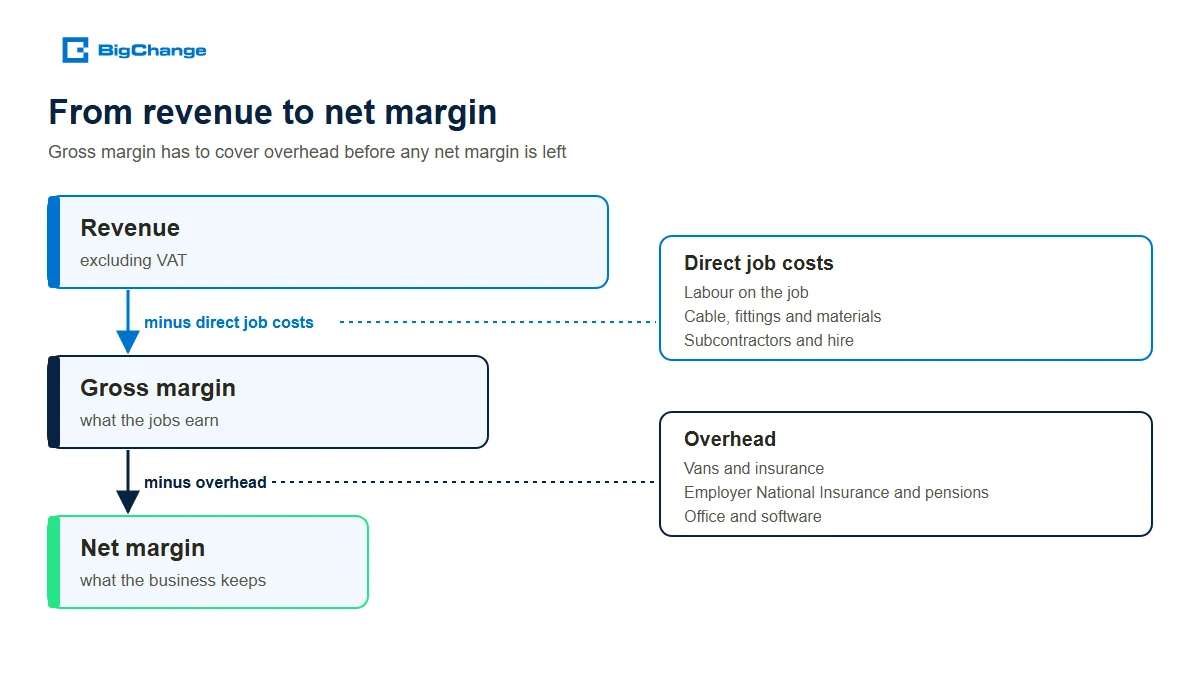
The UK costs that sit between gross and net margin
Employment costs are an overhead that is easy to underestimate. From April 2019 the minimum an employer pays into an automatic enrolment workplace pension is 3%, the employee pays 5%, and the total minimum contribution is 8%, according to GOV.UK workplace pension guidance. Build that cost into every hourly rate you quote.
The same GOV.UK pension guidance says that in most automatic enrolment schemes, contributions are based on total earnings between £6,240 and £50,270 a year before tax.
Employer National Insurance adds to the cost of each electrician whose earnings pass the secondary threshold. For 2026 to 2027 the Class 1 National Insurance secondary threshold is £96 per week, £417 per month or £5,000 per year, as HMRC's rates and thresholds for employers sets out.
Add vans, fuel, insurance, tools, office staff, software and certification costs. Divide the full annual cost of each electrician by the hours you can actually invoice, not the hours you pay. The result is the cost your hourly rate must clear before you make any profit.
Price without VAT, then add it
Calculate margin on VAT-exclusive figures, or you'll overstate it on every job you price. The UK standard VAT rate is 20%, according to GOV.UK VAT rates. Leave VAT out of both revenue and margin whenever you review a single job, a customer account or a whole month of your work.
Registration is the other trigger to watch. A business must register for VAT if its total taxable turnover for the last 12 months goes over £90,000, the VAT threshold, as GOV.UK's VAT registration guidance explains. If you're close to that line, model your prices both ways before you cross it.
Compliance work as recurring revenue
Compliance work can give an electrical business scheduled revenue that is less tied to the phone ringing. In England, the regulations require landlords to have the electrics in their rented properties checked at least every 5 years by a properly qualified person, according to GOV.UK electrical safety guidance for rented homes.
Portable appliance testing needs careful wording with customers. The Electricity at Work Regulations do not make inspection or testing of electrical appliances a legal requirement, nor do they make it a legal requirement to undertake this annually, as HSE's portable appliance testing FAQ explains. The same guidance says the Electricity at Work Regulations 1989 require that electrical equipment with the potential to cause injury is maintained in a safe condition. It also says annual portable appliance testing is not always necessary in low risk environments.
Sell testing as a way to show equipment is maintained safely, not as an annual legal must. Price compliance visits as scheduled work, keep them as their own revenue line, and book the next visit before the electrician leaves site.
Getting paid on construction work
On subcontract work, cash flow decides whether a good margin on paper survives. Under the Construction Act, a provision making payment under a construction contract conditional on the payer receiving payment from a third person is ineffective unless that third person is insolvent, according to section 113 of the Housing Grants, Construction and Regeneration Act.
The Act also sets the paperwork that keeps payment moving. A construction contract must require the payer or a specified person to give the payee a payment notice not later than five days after the payment due date, as section 110A sets out. Track every due date and notice on each job.
Where margin leaks between quote and invoice
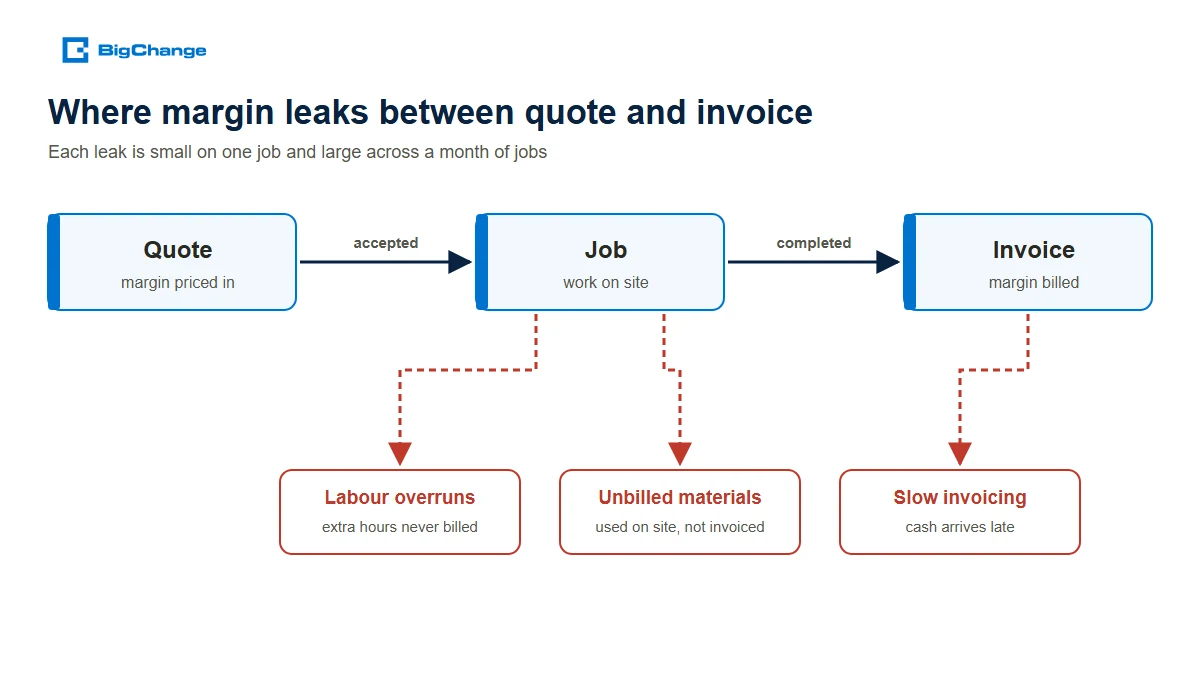
Margin you priced into a quote can disappear before the invoice goes out. Jobs can run over without the extra hours reaching the invoice. Materials can leave the van uncharged, and invoices can go out days after the work is finished. Together these small slips can explain why net margin falls short.
Close the gap with a weekly habit. Compare estimated and actual labour and materials on every completed job. Look for repeating patterns by job type or engineer, and feed what you find back into your prices.
KPIs that show whether your margin is healthy
Five numbers from your job records, checked on a fixed cycle, show when your electrical contractor profit margin starts to slip. Review gross margin by work type and net margin every month. A slide in one type of work then shows up in weeks, while you can still fix it, rather than at year end.
- Gross margin by work type: domestic, commercial, compliance and project work tracked as separate lines.
- Net margin, monthly: the clearest sign of whether overhead is under control.
- Average job value: track whether it rises as you add follow-on work.
- Quote acceptance rate: if nearly every quote is accepted, test whether your prices are too low.
- Callback rate: rework on invoiced jobs costs margin without showing up as a cost line, so track it per engineer.
To set prices that protect those numbers, see our electrical contractor price book guide, and compare the approach with our plumbing business profit margin guide.
Protecting your electrical contractor profit margin with BigChange
Materials and invoicing are two places where software can support margin control. BigChange's electrician software that connects jobs to invoices tracks electrical components, cables and tools in real time so electricians have the right materials for each job. Customers receive their invoices once the work is complete and can pay online.
BigChange invoicing lets businesses invoice accurately with detailed breakdowns of time and parts used, and invoice the moment work is completed to improve cashflow. Its reporting shows how you're performing so you can improve profitability.
To illustrate, Clearground, a building cleaning and maintenance provider, reports a 45% increase in job profitability in its BigChange success story.
Further, CCTV Monitoring puts it this way in its success story: "Our profitability per job is now typically 30 percent greater than before."
BCG reports that its Field Service AI deployments have delivered 10% to 15% productivity gains and 5% to 10% margin expansion, in its field service research.
Whatever system you consider, ask one question: does it show labour, materials and costs against each job before the invoice goes out? Book a BigChange demo to see it on your own electrical jobs.
Frequently asked questions
Do electrical contractors have to register for VAT?
Electrical contractors must register for VAT once taxable turnover passes the threshold. A business must register if its total taxable turnover for the last 12 months goes over £90,000, according to GOV.UK's VAT registration guidance. Price jobs on VAT-exclusive figures either way.
Is PAT testing a legal requirement in the UK?
The Electricity at Work Regulations do not make inspection or testing of electrical appliances a legal requirement, nor do they make it a legal requirement to undertake this annually, as HSE's PAT FAQ explains. They do still require equipment that could cause injury to be maintained safely.
How do you calculate gross profit margin?
You calculate gross profit margin by dividing gross profit by revenue and multiplying by 100. The formula is gross profit / revenue x 100 = gross profit margin, as the Start Up Loans guide shows. Gross profit is revenue minus direct job costs.
Can a main contractor refuse to pay until they are paid?
Under section 113 of the Construction Act, a provision making payment under a construction contract conditional on the payer receiving payment from a third person is ineffective unless that third person is insolvent. Check your own contract terms and payment notices before work starts.
How often does a rented property need an EICR?
Landlords in England must have the electrics in rented properties checked at least every 5 years by a properly qualified person, according to GOV.UK electrical safety guidance. That rule creates repeat inspection work for electrical contractors with landlord customers, so diarise each renewal date.