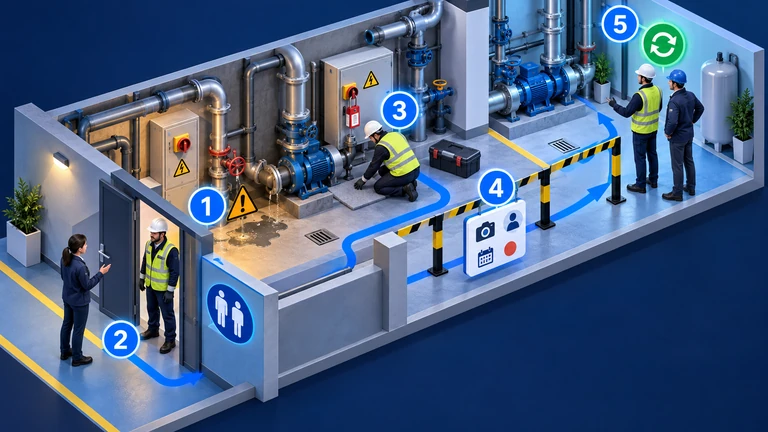
The Water Regulations 1999 don't flex around a quote that has gone stale. When a commercial client commissions a Legionella risk assessment under their statutory L8 duty, the engineer carries out documented, regulated work with a compliance paper trail attached. If the price behind that job doesn't account for the full cost of delivering it — the time on site, the risk assessment documentation, the follow-up reporting — the job loses margin before the client signs off.
That is the problem a plumbing contractor price book solves. Not abstractly, but in practice: every reactive callout, every unvented hot water cylinder installation under Part G Building Regulations, and every commercial maintenance round carries a real cost. Recovering that cost depends on whether the maths was done before the van left the yard.
For a sole trader quoting domestic work they know inside out, informal pricing is workable. For a business running multiple vans, delegating quotes to engineers who are not doing the costing themselves, or pursuing commercial contracts where procurement teams scrutinise every line, informal pricing becomes a structural risk.
If profitability has softened and you cannot identify why, keep reading.
What a Plumbing Price Book Actually Does for Your Business
A plumbing price book is the documented reference behind every quote and invoice your business sends. It records your loaded labour rates, material costs at actual merchant pricing after trade discounts, your markup structure across different job categories, and pre-built packages for the work you quote most often. Pricing an unvented cylinder replacement or a commercial backflow prevention inspection begins from a verified number rather than a figure someone recalls from a similar job earlier in the year.
The compounding value of consistent pricing is easy to underestimate. One job priced slightly under margin is inconsequential. Twelve months of the same job priced slightly under margin, because the flat-rate package hasn't been reviewed since copper or cylinder costs moved, is a profitability problem with no obvious cause.
UK plumbing carries a regulatory structure that makes informal pricing particularly hazardous. WaterSafe scheme membership, Part G Building Regulations notifications for unvented hot water work, L8 Legionella assessment obligations for commercial and HMO clients, and WRAS-approved fittings requirements under the Water Regulations 1999 all carry time and documentation obligations that need to appear in the cost of the job, not absorbed silently as unrecovered overhead.
Choose Your Pricing Model Before You Build Anything
The structure of your plumbing price book follows from the way the business actually sells work. Match the book to the model, and it becomes a practical daily tool. Mismatch them, and it creates as many problems as it solves.
For a deeper look at how different approaches play out across common plumbing job types, the guide to pricing plumbing jobs covers each model end to end.
Time and Materials
Time-and-materials (T&M) pricing bills clients for actual hours at your loaded labour rate, plus materials at a marked-up cost. Two things need to work correctly: a labour rate that reflects the genuine total cost of your plumbers on the road, and a material catalogue that is current.
T&M is right for jobs where the full scope cannot be established at the outset. Trace-and-access investigations for hidden leaks, emergency callouts to properties with unknown pipework, first-fix inspections on renovations where the existing system has not been seen yet — these are situations where the final invoice legitimately varies with the work done. The downside is that clients can push back on variable invoices, and profitability has a ceiling tied directly to estimating accuracy.
Fixed-Rate Job Packages
A fixed-rate price book assigns a firm price to a defined scope: one price for a cylinder-for-cylinder hot water replacement, one price for a pressurised unvented system installation with a Part G notification, one price for an annual Legionella risk assessment on a small commercial premises under ten outlets. Clients have certainty before the work starts. Your price book becomes a catalogue of pre-priced jobs, each one carrying labour, materials, overhead, and your target margin.
Fixed-rate pricing rewards productive engineers. A skilled plumber who completes a cylinder installation in less time than the job-costed hours improves the return on that package. The risk sits with you: stale cost assumptions inside the package mean you absorb the shortfall.